
QF7474. Farewell to the Qantas Queen of the Skies. (Part 1)
QF7474. Farewell to the Qantas Queen of the Skies. (Part 1)
A hallmark of the aerospace industry is its dynamic and ever-evolving nature. A little over a century has passed since the Wright Brothers made their momentous flights at Kitty Hawk in frail machines of rag and tube, and now we have private ventures flying to space stations and aircraft that can fly farther and faster than we once not dared to imagine.
Conversely, such a rate of advancement results in a sparsity of longevity. Today’s technology is often gone tomorrow. There have been some exceptions to the rule. The venerable Douglas DC3/C47 Dakota, the Boeing B-52 Stratofortress, and the Bell UH-1 ‘ Huey’ and their many sub-variants are just a few that come to mind – survivors of generational changes that have seen their contemporaries long consigned to boneyards and scrappers. At their core exists a sound design, yet with time such machines develop something more by evoking emotion in their operators and enthusiasts alike.
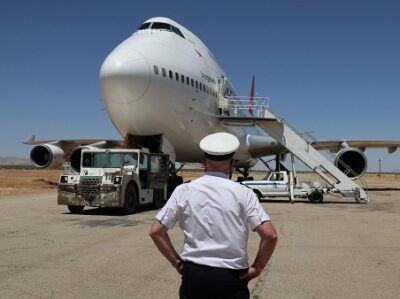
This emotion was no more evident than in July’s retirement of the final QANTAS Boeing 747 After 49 years of service, the final Qantas Boeing 747 leaves Australian soil for the final time, as VH-OEJ sets course for its final resting place in the US. After nearly 50 years of service with the airline. Spectators lined the runways and various other vantage points to wave goodbye, and a lucky few were privileged to take one last flight before VH OEJ was relegated to history.
In a final salute, the aircraft set course for Los Angeles and ultimately the Mojave Desert in a departure that had Sydneysiders craning their necks to the sky, and the world fascinated by what was etched upon their computer screens. It was a farewell to remember for many, and the culmination of incredible planning from a small team.
LONG MAY SHE REIGN
Like so many great stories, the Boeing 747 emerged from an unlikely combination of circumstances. Despite Boeing’s loss to Lockheed for the contract to build a massive military transport aircraft for the USAF in 1965 – which resulted in the Lockheed C-5A Galaxy – certain design features and technologies from Boeing’s bid were refined and retained.
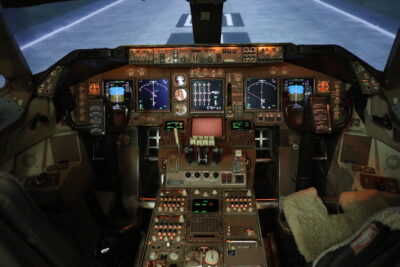
There was the emerging high-bypass engine technology that could be adapted to an airliner and, like their successful 707 line, the military contract had seen the rise of Boeing’s swept-wing aircraft as airliner contenders. Additionally, to allow the loading of equipment through the nose, the flight deck was positioned atop the cargo area.
As Boeing re-directed its focus to commercial air travel, the industry was witnessing unprecedented passenger numbers and lower airfares. The 707 had generated a revolution of its own, but PanAm founder Juan Trippe was keen to see an aircraft of far higher capacity take to the increasingly crowded skies to further drive down fares and significantly increase passenger numbers.
Even so, Trippe ultimately saw the rise of supersonic air travel as the future for passengers, meaning that his vision of a giant of the sky would need to provide for freighter conversion as it was superseded by speed. In December 1965, Juan Trippe and Boeing’s Bill Allen signed an initial order for 25 aircraft, in a US$25 million deal that had the potential to financially cripple both companies.
From the outset, the Boeing 747 had dimensions that dwarfed its predecessor, the 707. To be offered in both passenger and freight roles, the original 747 was over 220 feet long with a tail over 62 feet high, an increase of more than 50 per cent over the 707 in both aspects. So large was the design that Boeing needed to build a new facility at Everett in Washington state to cater for the 747 and, in doing so, constructed the world’s largest building by volume.
Moving from the 737 team, Joe Sutter was assigned the role of Chief Engineer for the development of the project, and history has come to know him as the ‘Father of the 747’. Along with a team of 50,000 at Boeing, they came to be known as ‘The Incredibles’ as they sought to create a commercial airframe and engine combination, the likes of which had not been seen before. But with the backdrop of the United States’ space program, it was a time when anything seemed possible.
In February 1969, the faith of so many was repaid when the prototype 747 first took to the skies, only five months before man stepped on the moon.
The 747 caught the interest of QANTAS very early in its genesis, with the Australian airline placing then changing its initial order for the 747-100 to four of the longer range 747-200s in 1967. The first QANTAS 747 arrived in August 1971, flying its first revenue service to Perth and Singapore a month later. It was the beginning of a relationship between airline and aircraft that would see QANTAS operate the 747 in a range of variants. Ultimately the airline would order 60 747s, from the -100s, which QANTAS leased, to the ‘Classic’ -200s and -300s, the distinctively shortened 747SP or Special Performance version, the -400s, and -400ER (Extended Range) models.
It was a union that endured for almost half a century and, for a period, marked QANTAS as the only all-747 airline in the world. As the landmark of 50 years approached, it was a sunset retirement that was to be celebrated by QANTAS for their airliner that democratised global air travel. That was until the COVID pandemic landed in 2020.
In the next post we will cover how a half century celebration in 2021 had to be pivoted to say farewell to the Qantas 747 in 2020 under the cloud and confines of the pandemic.
RECENT POSTS


