
Have I Become a Dinosaur?
Have I Become a Dinosaur?
Having spent nearly half a century in aviation, I find myself asking if I have become a dinosaur.
Every senior pilot’s lament since the Wright Brothers is how much aviation has changed since they first took flight. In my case, I have not witnessed the emergence of the monoplane or the dawn of the jet age, and I can only just remember watching Neil Armstrong step onto the moon’s surface. Even so, a great deal has changed – particularly in the development of automation.
My first serviceable autopilot came along when I started flying 737s, nearly a decade into my career. I had analogue dials and an endorsement for “DME homing” in my licence. Turboprops were rare beasts beyond the airlines, where the upper age to join was 27. Morse code was a requirement for an instrument rating.
My airline career has required me to remain abreast of change – from TCAS to RNP-AR and beyond. Terms that are now everyday but did not even exist that long ago. Still, it is possibly my grassroots flying instruction with new student pilots that has me challenging my place in this world.
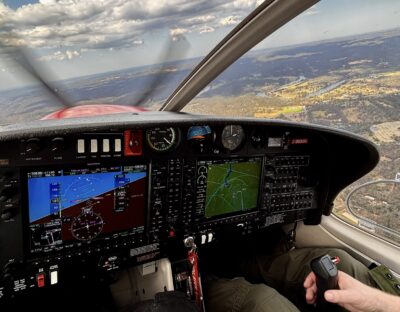
Preflight planning is done on iPads, where winds self-populate and calculate time intervals and fuel logs. The Garmin-equipped cockpits are coupled to approach-capable autopilots. Colour map displays with the option to overlay aeronautical charts. It seems endless, and I am continually impressed by the comfort and confidence with which even the newest pilot can navigate this technology.
And this leads me back to my question, “Have I become a dinosaur?”
I still believe that autopilots should be the tool laid upon the foundation of competent manual manipulation. And flight planning should have its origins in mental calculations and gross error checks. The underpinning skills and knowledge are different to my era, but is that my problem? I always consider the dark night when technology fails us and we need to rely on our core skills as aviators. And yet I caught a driverless car to dinner in San Francisco without question.
I recognise that time moves on, and there is no doubting that technological advancements have enhanced flight safety. However, have the very systems designed to keep us safer cracked the door on a new form of human vulnerability in an effort to reduce human error? Has an over-reliance on automation and technology allowed complacency to eat away at competency?
I don’t have the answer, but I will ask the question. Maybe I am just a dinosaur.
RECENT POSTS


