
QF7474. Farewell to the Qantas Queen of the Skies. (Part 3 – Final)
QF7474. Farewell to the Qantas Queen of the Skies. (Part 3 – Final)
PLANNING AN ADIEU & THE ROO.
When the farewell flights were conceived, so too was the plan to make the departure of OEJ a flight for all to remember. Central to the departure were three key elements – a flypast of Sydney harbour, a salute to the record-breaking and first 747-400, VH-OJA which is now in residence at the HARS Museum at Shellharbour Airport, and ‘sky art’ in the form of the QANTAS kangaroo.
The entire exercise had to be founded on a basis of safety and, to that end, each component was planned, trained,and executed according to a safety plan that needed to gain approval from CASA. Far from simply conceiving a route, myriad elements had to be addressed.
Unlike the farewell flights, OEJ would be operating at a significantly heavier weight, and flight margins needed to be considered accordingly. The crew would be in attendance at the event before departure and, with substantial flight time, potential fatigue issues needed to be addressed and satisfied. Security considerations and customs clearance at the QANTAS hangar, rather than the international terminal had to be organised. Calculating the weight and balance of the aircraft and loading it accordingly, with a cargo of many pets bound for the US. The list went on.
Captain Weaver drew together teams from all areas within the airline. Matthew Bouttell as manager of Air Traffic Management was responsible for organising the complex airways clearances, as well as designing the Temporary Restricted Area (TRA) that was needed to safely overly the HARS Museum outside controlled airspace.
The navigation team led by Cass Moeller and Jevan Wong were tasked with tailoring the existing flight planning system to incorporate the many complex waypoints involved in drawing the sky art and calculating the fuel requirements.
Catering was needed to provide a non-standard configuration of meals for the crew, and the refuellers had to load the aircraft to maximum limits without fuel overflowing through the surge tanks. The Airports Team and Sydney Airports Corporation Limited (SACL) had to confirm the pavement strength in the alley way from the hangar where OEJ would taxi at a weight of 368,000 kg.
The QMET section was consistently providing weather and upper wind forecasts, as the sky art and flypasts were weather–dependent upon predefined parameters – another reason for the secrecy. Furthermore, they were continually organising weather forecasts for Mojave as they are not normally provided.
The engineering team had to prepare the aircraft for international flying once again, ground testing the autopilot for auto–land capability, and configuring the cabin for its ultimate state when finally parked in the boneyard, among many other tasks. The event itself at QANTAS Hangar 96 fell on the shoulders of the QANTAS Events Team, while the associated media was managed by the Communications Department, led by Amanda Bolger.
The crew for the flight had been selected weeks before. Sharelle Quinn, the first female QANTAS Captain, and the airline’s most senior 747 Captain Ewen Cameron, would fly the initial departure. Also, onboard would be Captains Owen Weaver and Greg Fitzgerald, First Officer Quin Ledden, and your writer, Second Officer Owen Zupp. Together, the crew had over 124,000 hours of flight experience, including more than 78,000 hours on the 747.
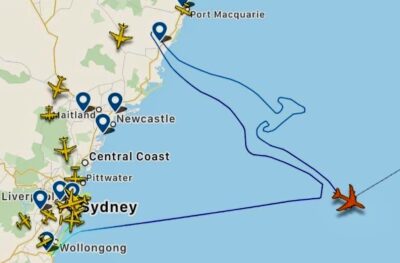
The centrepiece of the departure was set to be the sky art kangaroo, yet when Captain Weaver first conceived theidea, he wasn’t even sure if it was possible. In the first instance, he overlaid the outline in Google Earth Pro and generated a series of waypoints. As these were expressed in decimal points, all 75 had to be converted into latitudes and longitudes. Scaling the sky art was the next challenge. Turns had to be of a radius within the capability of the heavily-laden 747 and of a size and location to be seen by the flight tracking ‘apps’ without dropping out of ADS-B coverage.
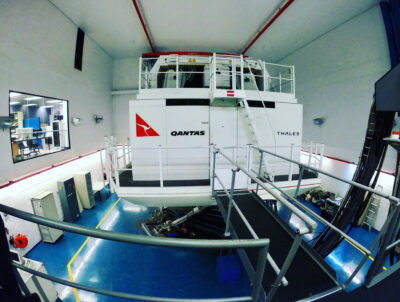
Captain Weaver flew a series of secretive simulator sessions with Captain ‘Marty’ Gardiner in a range of configurations to trial the kangaroo. Finally, remaining below 20,000 feet so that flaps could be extended and then utilising Flaps 20 and the autopilot, all turns within the ‘Roo’ could be safely flown.
With the approval and co-operation of the Royal Australian Air Force, the airspace was made available. The flight crew then made a series of visits to the flight simulator where the various elements of the departure were rehearsed as well as the arrival into Mojave. The scene was finally set.
FAREWELL TO THE QUEEN.
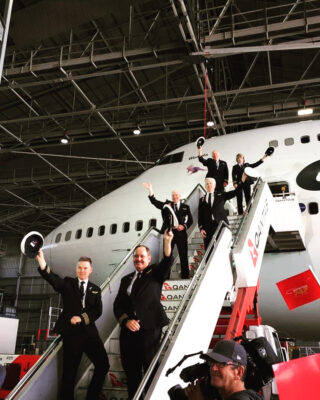
The QANTAS Hangar 96 was abuzz with gathered guests and dignitaries. CEO Alan Joyce spoke of the significance of the 747 to the airline’s history, and First Officer Geoff Cowell recited a moving poem dedicated to his steed.
Media moved about busily, and all present were invited to sign their names and a message on the belly of ‘Wunala’. The numbers were scaled down due to COVID, but the appreciation of a fitting farewell was not lost amid the excitement.
The crew mingled with the guests, with Captains Weaver and Fitzgerald discreetly sneaking away to enter and cross-check the 75 waypoints of the ‘Roo’ sky art into the Flight Management Computer (FMC). It had been hoped that the hard work of the navigation and “Constellation” flight planning teams would allow an automatic uploading of the waypoints, however, an earlier trial had shown it to be beyond the capability of the 747’s FMC. With the final words and waves completed, the crew took their stations and after pushback and an intermediate stop to finalise loading the aircraft, we were underway.
The initial departure involved a turn to the west before returning to overhead Sydney Airport, so Runway 16 Right was offered up by Air Traffic Control to maximise separation from the Bankstown Airport airspace. The subsequent taxi out was a tour of water cannon salutes, media helicopters, and hundreds of gathered well-wishers at the ‘Shep’s Mound’ spotters park, in front of which Captain Quinn paused QF7474 – again, a flight number that had presented an IT challenge.
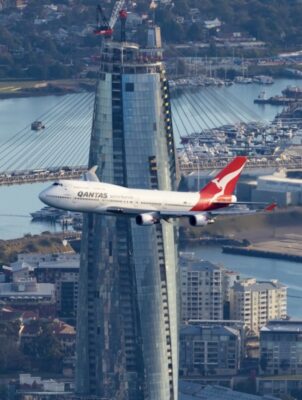
Image: Seth Jaworski.
As the thrust levers moved up, the flight deck was focussed on the task rather than the emotion. Over the next hour, they managed the 747’s extensive radius of turn to cross the coast at the designated points, aware of the gatherings beneath. The sight of the Harbour Bridge and Opera House passing 1,500 feet below were spectacular, as a lap along the Parramatta River terminated with a reversal turn and a second overflight.
Air Traffic Control wished them well as the aircraft tracked coastal to Shellharbour where OJA and a substantial crowd looked skyward. The radio broadcasts from Wunala were met with a response and tribute for those below. A pass along the runway, a left turn out to sea and the final QANTAS 747 had departed Australia.
Unknown to the crew, more than a quarter of a million people were watching the track they were flying as they approached the commencement of the sky art. But only when the various wind and weather parameters were confirmed was the final go-ahead decided upon and the QANTAS Integrated Operations centre (IOC) advised to release the well–kept secret.
Some thought the initial turn was the 747 returning to Australia for some reason, but it soon became apparent there was something special in–store. For the next ninety minutes the ‘Queen of the Skies’ etched her goodbye in the sky. Accelerating along the extended lines of the kangaroo’s back and tail and decelerating and extending flaps to manoeuvre around the paws and other tighter turns. By the time the art was complete, the sun had set, and so too had QANTAS 747 operations in Australian airspace.
Now the Pacific beckoned for one final time.
ONE LAST HOP.
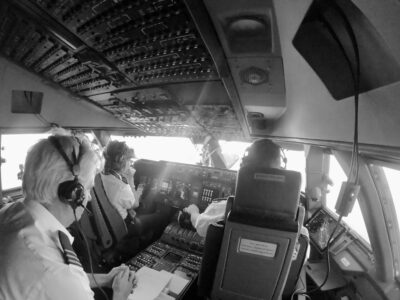
The arrival into Los Angeles for the crew was somewhat surreal. Familiar with the rapid–fire radio transmissions and multiple targets on the Traffic Collision Avoidance System (TCAS), the COVID-affected airwaves and airspace were uncharacteristically and eerily quiet.
When Captain Quinn finally brought Wunala to a halt, a walkway was extended and the crew was met by mask-wearing staff as they fitted their own. At the airport’s perimeter fence and LAX’s famous but unofficial Imperial Hill spotters park, another crowd of enthusiasts and expats had gathered to welcome the aircraft and crew, some waving Australian flags.
After nearly 48 hours locked down in their Manhattan Beach apartments, the crew readied for the final 20-minute sector to the Mojave Air and Space Port. Captain Cameron would fly in command with Captain Fitzgerald alongside him in a fitting end to their substantial QANTAS careers. Both pilots had rehearsed the sector in the simulator numerous times, aware of the proximal terrain and the nearby airspace of the famous Edwards AFB facility and other sensitive facilities.
The QANTAS Base Manager at Los Angeles Airport had something special in mind to say goodbye. An Australian style barbeque of sausages, bacon, and eggs to the accompaniment of ‘I Still Call Australia Home’ being sung by the present staff was a very moving moment. Two dedicated 747 cakes were cut to a backdrop of QANTAS banners and pedal car, and the sense of a QANTAS family was as strong as it could possibly be.
One final walkaround inspection, one final engine start and one last taxi out for take-off, this time at a weight of only 228,000 kg. Water cannons again said goodbye as hundreds of QANTAS staff and other airport workers lined the taxiway, and emergency vehicles ahead and on the flanks escorted the Boeing 747 to the runway’s end. A last farewell from Air Traffic Control and a clearance to take-off, and the aircraft took to the skies from RWY 25L beneath Captain Cameron’s hands as helicopters filmed and the people below waved.
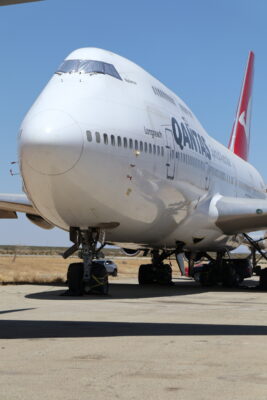
A right turn and climb to only 13,000 feet, the 747 cut through the clear air, crossing the coast overhead Malibu and set course for the desert and Mojave. Numerous light aircraft populated the TCAS, possibly catching one last look. To stay well clear, the crew brought the 747 into a sweeping left orbit near Mojave airfield until the sky was empty once again. Joining overhead, a visual circuit was flown, and the runway loomed ahead. The long black strip grew larger until Captain Cameron finally eased Wunala to earth for the final time.
Aside from the mandatory checks and calls, the flight deck was quiet as the aircraft was taxied and parked in a line astern to three QANTAS 747 sisters already in residence. The crew each took their turn at shutting down an engine and putting OEJ to bed for the final time. Only then, with the task finally complete, did the focus shift to reflection on what this all meant.
On the ground, the crew were met by more media and answered questions beside the now-quiet 747, although it was impossible to ignore the sad sight of hundreds of scrapped airliner hulks on the far side of the airfield. Perhaps it was those mixed emotions, perhaps it was a weariness, but very few words were spoken on the two-hour bus ride back to their accommodation.
Undoubtedly, it was the realisation that this was the end of an era and, for some, a career. To be part of such an event was a privilege that was not lost upon the crew. And it was an absolute honour to farewell the ‘Queen’.
RECENT POSTS


