
If These Walls Could Speak.
If These Walls Could Speak.
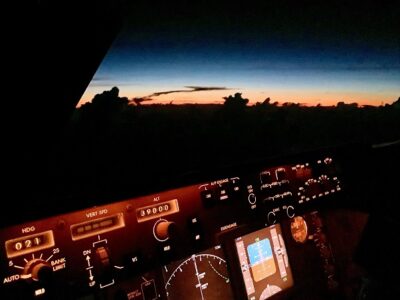
This week marked 98 years since Kingsford Smith and his crew crossed the Pacific Ocean. It was an epic undertaking that left an even greater mark upon me when I was able to sit in the Southern Cross and appreciate the rudimentary nature of the aircraft in which they completed this epic flight. It is two decades and many Pacific Crossings for me since I wrote the piece below. Still, with each crossing in comfort, I am still in awe of what was achieved.
After 14 hours of extended night, a 747-400 rolls onto final approach at Brisbane Airport. Gear down, final flaps and checks complete, the modern monolith readies for its return to earth after what seems an eternity to its 350 passengers. As the wheels smack the 1500’ markers, the blue smoke puffs from the tyres and another trans-Pacific epic is over. A mere matter of wingspans away from the 747’s final place of docking, one can almost hear the contempt of the use of the term ‘epic’ rising from a landscaped garden and discreet glass-fronted hangar. Within these glazed walls stands a worthy recipient of the terms pioneer and legend. Within these glazed walls stands Sir Charles Kingsford Smith’s ‘Old Bus’, The Southern Cross.
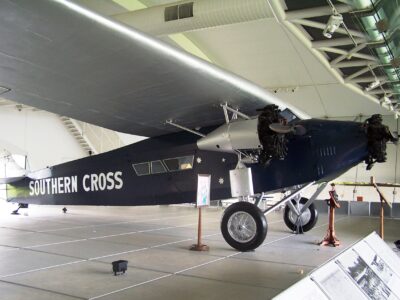
The Fokker Tri-Motor stands proudly, wrapped in a carefully controlled air-conditioned environment and surrounded by artifacts and plaques relating to its days of glory. Retired, but not forgotten, its current home pays due respect to the trials and tribulations of its historic past but is a far cry from the weather-lashed reality of its heroic adventures. To view the Southern Cross, up close and personal, is a rare privilege. Inside the confines of its stable and approaching across the clean, grey floor, one cannot help but be struck with a sense of awe and reverence. This is not a replica; this is the actual craft that wrote history. An integral part of Australian aviation heritage from a time before pressurisation, GPS and affordable safety; a time of Bradman and Phar Lap.
“Southern Cross” is boldly displayed in silver along its navy blue flanks, though this was not always the case. The Fokker FVIIB had originally been owned by Antarctic explorer, Sir Hubert Wilkins and suffered through a series of trials in Alaska before coming to grief. In 1928, the fuselage and wings were subsequently bought by ‘Smithy’ and his Trans-Pacific cohort, Charles Ulm and at this time the manufacturer’s name, ‘Fokker’, graced its sides. Fitted with new Wright Whirlwind engines on its nose and silver wings, Smithy flew a series of endurance testing flights before the name “Southern Cross” was proposed by another of the team, Keith Anderson. What was to become its permanent trademark was actually supplemented by a reference to a truck manufacturer, “Faegol Flyer”, along with “The Spirit of California” in somewhat smaller sign writing. These latter examples of “American Graffiti” were removed for the trans-Pacific conquest. Ultimately, the Australian registration of “VH-USU” would adorn the fuselage in company with its name.
If the bearing of the machine impacts upon the spirit, making one’s way to the door on the starboard side is ripe with anticipation. Stooping to gain access through what is best described as a hatch, the interior is now manned by a lone wicker chair and a brass fire extinguisher that still hangs at the ready. Within this chamber, Jim Warner would strain against the deafening roar to detect the hint of a radio signal that may lead them to land as they traversed the Pacific. Nearby, Harry Lyon plotted the Southern Cross’ course in one of the great efforts of dead reckoning. Thrashed by weather and incessant vibration, Lyon’s sextant was of limited value and he relied on the constant of time, heading and groundspeed. Drift was calculated by throwing powder by day and flares by night into the Pacific below and subsequently flying a constant heading. Such rudimentary techniques safely saw the intrepid aviators cross over 11,000 km of ocean by day and night in three historic legs. Whilst seat pitch may not have been an issue in the Southern Cross’ cabin, there were few other ‘positives’. The noisy, draughty environment rendered communication ineffective and left the crew temporarily deaf after shutdown. Messages were exchanged between the cabin and cockpit by means of a stick with notes pinned to the end. These notes were not only used to relay operational information, but also humorous and uplifting messages between the crew as they set about defying the odds. In later life, the cabin played host to 12 passengers in joyflight operations, or 8 in the upmarket role of airline transport. Today, the tube and fabric hull hold only memories.
From a pilot’s perspective, the step up into the cockpit is more than tinged with anticipation. Beyond the cabin’s central fuel tank and through the narrow opening sit scant dials, three throttles and the seats that carried Kingsford Smith and Ulm. Entry to the cockpit would pose a distinct challenge to a larger man as one ducks beneath the doorway and weaves between the seats. Finally in position, being careful not to take a handhold on some historic and irreplaceable lever, I gingerly lower myself into the historic left-hand seat. The dials sit ahead of me and it is impossible not to feel some link with the past as I take a grip of the control wheel. Scanning to the right, Ulm’s chair sits vacant and the rustic nature of the rag and tube flight deck is evident. Over the nose visibility is impinged by the cylinders and exhaust stack of the central radial engine; the same culprit engine that blew its exhaust manifold over the Tasman Sea and sent a renegade part hurtling into the starboard propeller with devastating results.
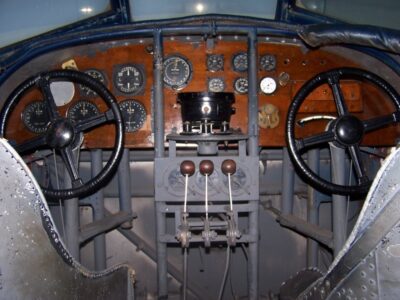
Further dominating the rather obscured view from Smithy’s seat are the broad wings of the Southern Cross. Painted silver, one is struck by the thickness of the aerofoil that is obviously built for lift and not for speed. Within are housed four fuel tanks that are managed by a Heath-Robinson fuel panel behind the pilot’s right shoulder. The ergonomics of this machine only add to the awe of the undertaking. These huge hoary wings also served to provide shade for the crew when they found themselves alone in the Kimberleys in 1929. Having been flying in excess of 24 hours since departing Sydney and lost in the remote northwest, Smithy finally put the aircraft down on the mudflats where they would wait twelve days for rescue. The episode came to be known as the “Coffee Royal Affair” after the crew had combined spirits with coffee whilst stranded. Aspersions were cast on the integrity of Smithy and Ulm at the time, with unfounded rumours of a publicity stunt circulating. The drama was further heightened by the loss in central Australia of Keith Anderson and Bill Hitchcock in their Westland Widgeon as they searched for the missing men. Anderson had been a long-term compatriot of Kingsford Smith and the man originally responsible for naming the Southern Cross years before. Damaged, but undaunted, Smithy would continue on and ultimately be the first man to circumnavigate the globe in the same aeroplane. Even so, the stigma of “Coffee Royal” remained.
Whilst the wings and engines dominate the view to port and starboard, an interesting feature is the absence of glass. Whilst there lies a central windscreen, pilots are exposed to the elements, noise and churning airflow through the void on their respective shoulders. It almost defies the imagination to conjure the conditions experienced on the long haul of pioneering international flights. Even so, there were instances when even the relative comfort of the cockpit could not be enjoyed. In May 1935, when the starboard engine had its propeller shattered over the Tasman Sea and was subsequently shut down, it left the remaining engines labouring to keep the Tri-Motor aloft. Trans-Tasman co-pilot P.G “Bill” Taylor climbed through the absent window on the starboard side and drained oil from the defunct engine. Transferring the life-giving fluid to the failing port engine was a different matter as the operating engine complicated the process with its propwash, as John Stannage discovered when attempting the second stage of the transfer. Smithy subsequently set about climbing and descending the Southern Cross to allow the left throttle to be retarded on the downward slide, thus enabling a slightly thawed Taylor to complete the job. The transfer was repeated and the precious mail was dumped before the Australian coastline finally came into view. Right engine shutdown, left engine struggling and the centre engine on the verge of failure, the ‘Old Bus’ staggered to a three-pointer at Mascot after fifteen hours in the air.
This was to be the last major flight for the Southern Cross. Smithy knew that after 300, 000 miles his old bus was approaching its ‘use by’ date and so he parted company with his trusty steed at RAAF Richmond in 1935. Her final flight occurred some years later when she was used in a film recounting the life of her famous owner. Subsequently, in 1958, the Fokker Tri-Motor became a central exhibit at Brisbane’s Eagle Farm Airport, where she stands today.
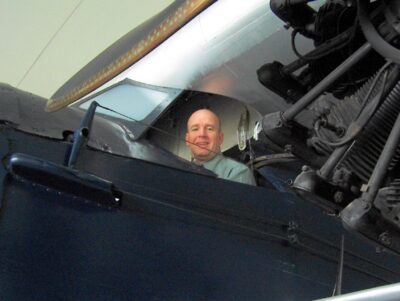
To enjoy the privilege of encountering the Southern Cross at close quarters is a profound experience for any devotee of aviation history. In our present-day disposable society, longevity is a rare commodity. The stark, rudimentary nature of the aircraft flies in the face of the contemporary standpoint. It is basic, rugged and low on technology, but high on mystique. Within its fabric shell and its elevated cockpit, the atmosphere is tangible. A boyhood of aviation’s tall tales and true seems to seep from every corner of the “Old Bus”. Much of the Southern Cross’s extraordinary life is well documented and has been subjected to scrutiny time and again. Yet, as I sit at the sharp end of this historic machine and imagine a myriad of frozen, oil-spattered moments, I can’t help but feel that there is still much left unsaid. Memories that lie at the bottom of oceans and have passed with the men who made them. Perhaps it is better this way, but one cannot help but wonder if these walls could speak.

RECENT POSTS


